
Given some target cooling budget, how much more performance can I get out of an ASIC versus an FPGA for this application, given my ASIC will be two tech nodes behind the FPGA?
Analytic Models
From the smallest embedded system to the largest warehouse-scale computing infrastructure, from the most well-characterized CMOS technology node to novel devices at the edge of our understanding, computer architects are expected to be able to speak to concerns of energy, cost, leakage, cooling, complexity, area, power, yield, and of course performance of a set of designs. Even radical approaches such as DNA-based computing and quantum architectures are to be considered. While careful application of detailed simulation can accurately estimate the potential of a specific microarchitecture, exploration across higher level questions always involves some analytic models.
Questions like the one above come up all the time, and the explosion of domain-targeted computing solutions means that more and more people are being asked to answer these questions accurately and with some understanding of the confidence in those answers. While any Ph.D. in Computer Architecture should be able to answer this question, when you break it down, it requires a combination of a surprisingly complex set of assumptions. How do tech node and performance relate? What is the relationship between energy use and performance? ASIC and FPGA performance? Dynamic and leakage power? Temperature and leakage? Any result computed from these relationships will rely on the specific relationships chosen, on those relationships being accurate in the range of evaluation, on a sufficient number of assumptions being made to produce an answer (either implicitly or explicitly), and finally on the end result being executable to the degree necessary to explore a set of options (such as for a varying parameter e.g., total cooling budget).
What is Charm?
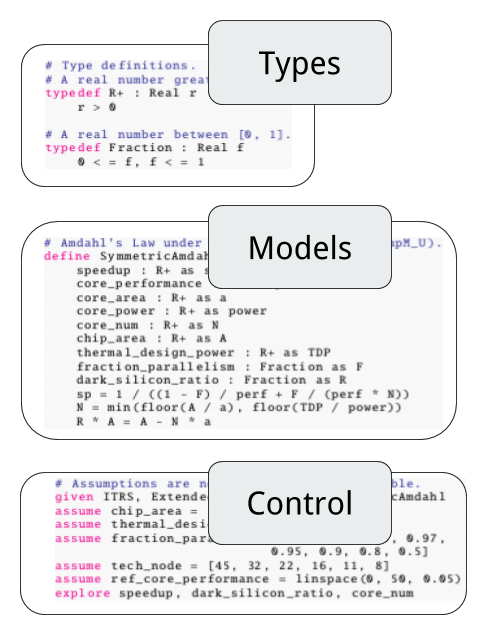
Charm is a modeling language that provides a concise and natural way to express architectural relationships and declare analysis goals. By combining symbolic manipulation, constraint solving, and compiler techniques, Charm bridges the gap between mathematical equations and executable, optimized evaluation functions and analysis procedures.
Clean Abstraction
Charm encapsulates a set of mutually dependent relationships and supports flexible function generation. It enables representation of architecture models in a mathematically consistent way. Depending on which metric the model is trying to evaluate, Charm can generate corresponding functions without requiring the user to re-write the equations. It also modularizes high-level architecture models by packing commonly used equations, constraints and assumptions in modules. These architectural “rules of thumb” can then be easily composed, reused and extended in a variety of modelling scenarios.
Model Consistency Checking
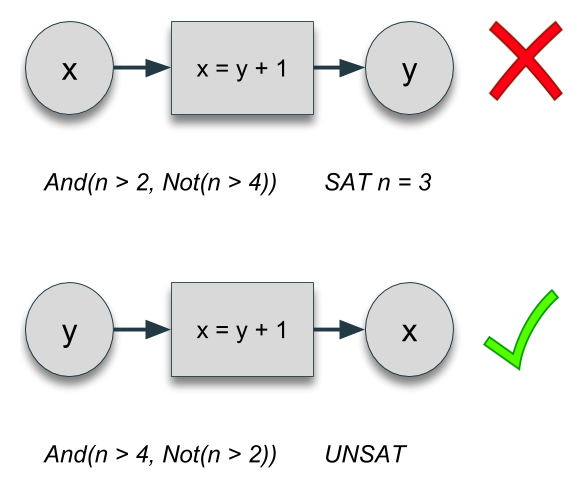
Charm enables new static and run-time checking capabilities on high-level architecture models by enforcing a type system in such models. One example is that many architecturally meaningful variables have inherent physical bounds that they must satisfy; otherwise, although mathematically viable, the solution is not reasonable from an architectural point of view. With the type system built-in, Charm can dynamically check if all variables are within defined bounds to ensure a meaningful modelling result. The type system also helps prune the design space based on constraints, without which a declarative analysis might end up wasting a huge amount of computing effort in less meaningful sub-spaces.
Composition and Optimization
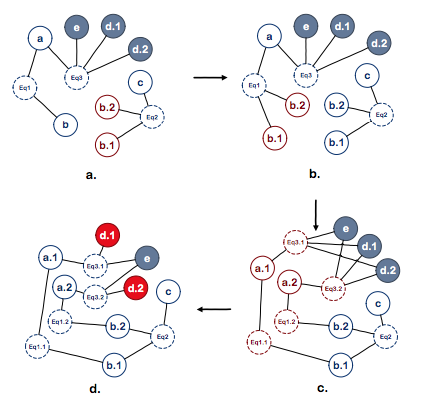
Charm automatically manages multiple “instances” of sets of equations that naturally occur in architecture models. It further opens up new opportunities for compiler-level optimization when evaluating architecture models. Although high-level architecture models are usually several orders of magnitude faster than detailed simulations, as the model gets complicated or is applied many times to estimate a distribution, it can still take a non-trivial amount of time to naively evaluate the set of equations every iteration. By expressing these complicated models in Charm, we are able to identify common intermediate results to hoist outside of the main design option iteration and/or apply memoization on functions.
Play with Charm
Charm is open source and available on GitHub. The short video below walks through the idea.
Architectural Risk
Designing a system in an era of rapidly evolving application behaviors and significant technology shifts involves taking on risk that a design will fail to meet its performance goals. While risk assessment and management are expected in both business and investment, these aspects are typically treated as independent to questions of performance and efficiency in architecture analysis. As hardware and software characteristics become uncertain (i.e. samples from a distribution), we demonstrate that the resulting performance distributions quickly grow beyond our ability to reason about with intuition alone. We further show that knowledge of the performance distribution can be used to significantly improve both the average case performance and minimize the risk of under-performance (which we term architectural risk). Charm can be used to quantify the areas where trade-offs between expected performance and the “tail” of performance are most acute and provide new insights supporting architectural decision making (such as core selection) under uncertainty.
Performance vs. Risk
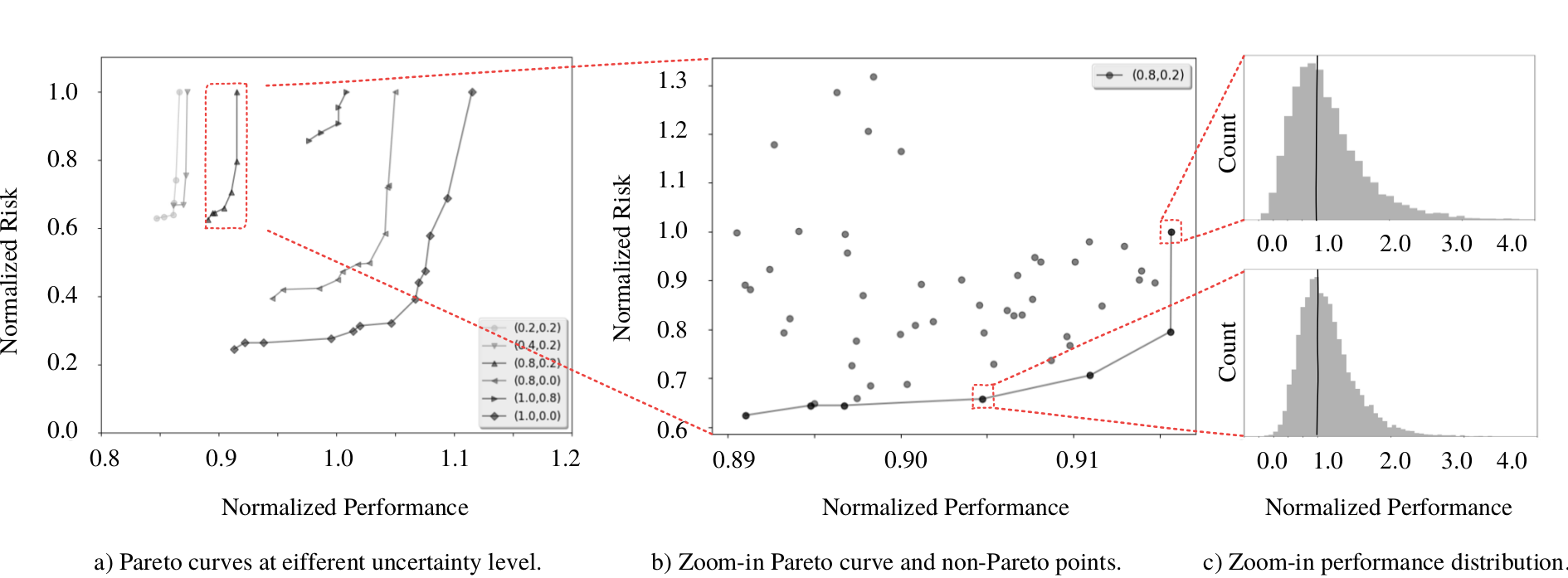
We can tell that the amount of input uncertainty shifts the possible outcomes of all designs in the performance-risk space and determines what the trade-off space looks like. In most cases, there exists a trade-off space between the performance-optimal design and the risk-optimal design. Taking the curve marked as an example, one can mitigate almost 60% of risk at the cost of less than 3% performance. Zooming in on the example curve, we show both the Pareto-optimal designs as well as the non-optimal designs with relatively strong expected performance (within 89% of the best expected performance) in the space. Further zooming in on the two representative designs on the Pareto curve, we can see that having a more “concentrated” distribution around the performance goal helps bring down the architectural risk of the lower design, while the upper design has a wider distribution leaving a larger risk but better expected performance.
Core Selection
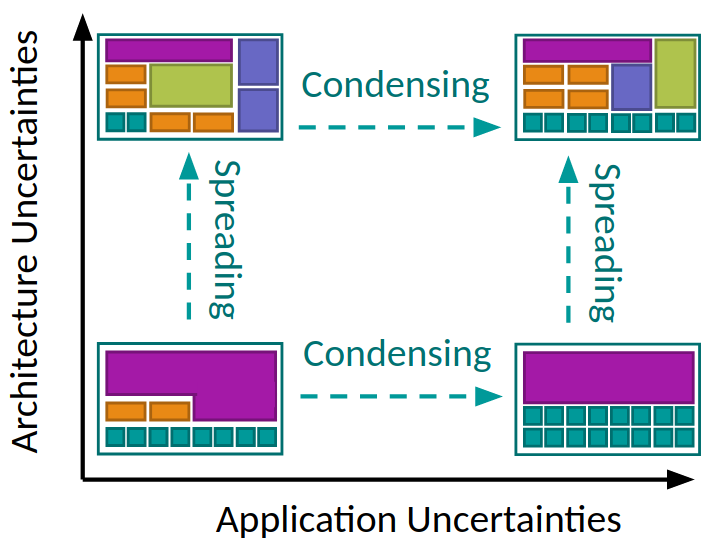
If we consider application uncertainty alone, when it gets larger, more asymmetric configurations are generally favored. This trend results from the asymmetric impact of uncertainty. A large core is needed to compensate for the performance loss while the herd of small cores are better performing than a distribution of heterogeneous cores for parallel execution. However, when architecture uncertainty gets larger, we can see that less asymmetric configurations are preferred due to the fact that a mid-sized core can step in during serial execution to compensate for the performance loss due to a less performant large core. Another reason is that multiple cores of each type are chosen to fight the intra-die process variation, leading to fewer core types on chip because of total area/resource constraint. These two counter-directional trends are the main reasons that the design space is very irregular and complicated.
Publications
- Efficient Uncertainty Modeling for System Design via Mixed Integer Programming. Zichang He, Weilong Cui, Chunfeng Cui, Timothy Sherwood, Zheng Zhang. International Conference On Computer Aided Design (ICCAD), November 2019.
- Language Support for Navigating Architecture Design in Closed Form. Weilong Cui, Georgios Tzimpragos, Yu Tao, Joseph McMahan, Deeksha Dangwal, Nestan Tsiskaridze, George Michelogiannakis, Dilip Vasudevan, Timothy Sherwood. ACM Journal on Emerging Technologies in Computing Systems (JETC), October 2019.
- Charm: A Language for Closed-Form High-Level Architecture Modeling. Weilong Cui, Yongshan Ding, Deeksha Dangwal, Adam Holmes, Joseph McMahan, Ali Javadi-Abhari, Georgios Tzimpragos, Frederic T. Chong, Timothy Sherwood. International Symposium on Computer Architecture (ISCA), June 2018.
- Architectural Risk. Weilong Cui, Timothy Sherwood. IEEE Micro: Micro's Top Picks from Computer Architecture Conferences, May 2018. (IEEE Micro Top Pick)
- Estimating and Understanding Architectural Risk. Weilong Cui, Timothy Sherwood. IEEE/ACM International Symposium on Microarchitecture (MICRO), October 2017.