
What happens if we try to do computation with values encoded only as times?
Computing with Time
When extremely low-energy processing is required, the choice of data representation makes a tremendous difference and we have much to learn from nature in this regard. For example the brain seems to use some form of “time-based” representations – encodings where the temporal relationship between spike arrivals carries useful information. This research asks the seemingly simple question: what happens if we try to do computation with values encoded only as times?
You can read a great summary of our race trees work by Adrian Colyer on the morning paper.
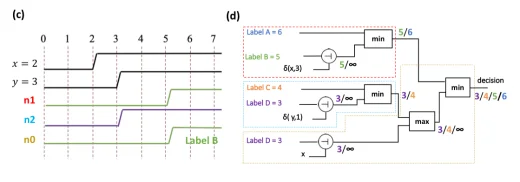
While we don’t know how to fully answer that question yet, our early results are encouraging and point to radically more energy efficient forms of computing. Under “race logic” information is represented as a timing delay, and a set of basic operations – MIN, MAX, ADD-CONSTANT, and INHIBIT – describe the basic set of “temporal operators” replacing the AND, OR, NOT we know and love from digital logic.
- MAX
Given two input events arriving at time T1 and T2, output an event at time max(T1, T2).
- MIN
Given two input events arriving at time T1 and T2, output an event at time min(T1, T2).
- ADD-CONSTANT
Given one input event arriving at time T, output an event at time T+K for some constant K.
- INHIBIT
Given a data input arriving at Td and a control input arriving at Tc, output an event at time Td if and only if Td < Tc.
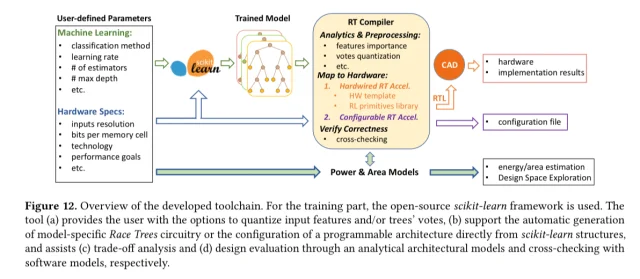
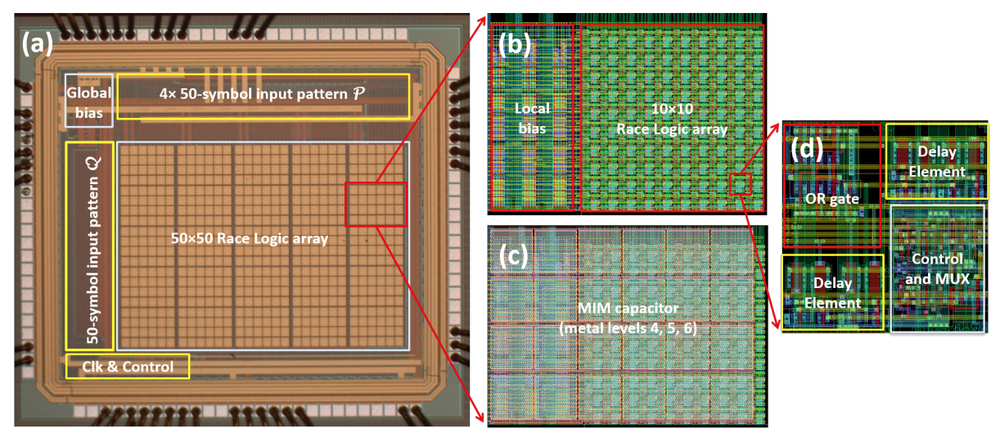
The core idea of race logic is to deliberately engineer “race conditions” using these operators, where the time it takes to complete a task tells you the answer you are looking for. For example, we have constructed systems where the time it takes for a signal to reach the output tells you how closely related two sequences of DNA are to one another, or how to classify an image from a collection of digits.
Edges as a Proxy for Spikes
A Practical Analog Implementation of Race Logic

Publications
- Delay-Space Arithmetic and Architecture. Rhys Gretsch, Peiyang Song, Advait Madhavan, Jeremy Lau, Timothy Sherwood. IEEE Micro: Micro's Top Picks from Computer Architecture Conferences, July 2025. (IEEE Micro Top Pick)
- Single Spike Artificial Neural Networks. Rhys Gretsch, Michael Beyeler, Jeremy Lau, Timothy Sherwood. Annual International Symposium on Computer Architecture (ISCA), June 2025.
- Energy Efficient Convolutions with Temporal Arithmetic. Rhys Gretsch, Peiyang Song, Advait Madhavan, Jeremy Lau, Timothy Sherwood. International Conference on Architectural Support for Programming Languages and Operating Systems (ASPLOS), April 2024.
- In-sensor classification with boosted race trees. Georgios Tzimpragos, Advait Madhavan, Dilip Vasudevan, Dmitri Strukov, Timothy Sherwood. Communications of the ACM (CACM), May 2021. (CACM Research Highlight)
- From Arbitrary Functions to Space-Time Implementations. Georgios Tzimpragos, Nestan Tsiskaridze, Kylie Huch, Advait Madhavan, Timothy Sherwood. Workshop on Unary Computing (Unary) held in conjunction with ISCA, June 2019.
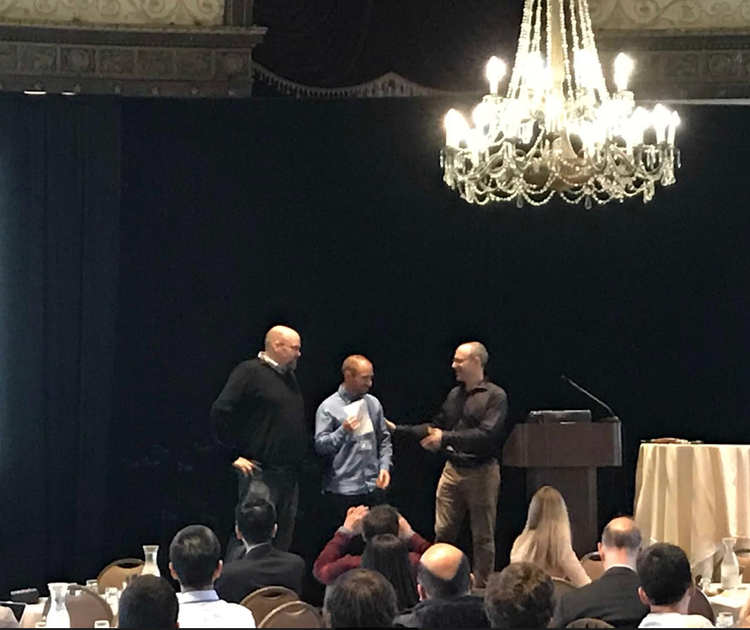
- Boosted Race Trees for Low Energy Classification. Georgios Tzimpragos, Advait Madhavan, Dilip Vasudevan, Dmitri Strukov, Timothy Sherwood. International Conference on Architectural Support for Programming Languages and Operating Systems (ASPLOS), April 2019. (Best Paper Award)
- High-Throughput Pattern Matching With CMOL FPGA Circuits: Case for Logic-in-Memory Computing. Advait Madhavan, Timothy Sherwood, Dmitri Strukov. IEEE Transactions on Very Large Scale Integration Systems (TVLSI), June 2018.
- A 4-mm2 180-nm-CMOS 15-Giga-Cell-Updates-per-Second DNA Sequence Alignment Engine Based on Asynchronous Race Conditions. Advait Madhavan, Timothy Sherwood, Dmitri Strukov. IEEE Custom Integrated Circuits Conference (CICC), April 2017.
- Energy Efficient Computation with Asynchronous Races. Advait Madhavan, Timothy Sherwood, Dmitri Strukov. Design Automation Conference (DAC), June 2016.
- Race Logic: Abusing Hardware Race Conditions to Perform Useful Computation. Advait Madhavan, Timothy Sherwood, Dmitri Strukov. IEEE Micro, March 2015.
- Race Logic: A Hardware Acceleration for Dynamic Programming Algorithms. Advait Madhavan, Timothy Sherwood, Dmitri Strukov. International Symposium on Computer Architecture (ISCA), June 2014.
- Memristors for Neural Branch Prediction: A Case Study in Strict Latency and Write Endurance Challenges. Heba Saadeldeen, Diana Franklin, Guoping Long, Charlotte Hill, Aisha Browne, Dmitri Strukov, Timothy Sherwood, Frederic T. Chong. ACM International Conference on Computing Frontiers (CF), May 2013.
- Hybrid CMOS/Nanodevice Circuits for High Throughput Pattern Matching Applications. Fabien Alibart, Timothy Sherwood, Dmitri Strukov. NASA/ESA Conference on Adaptive Hardware and Systems (AHS), June 2011.